Every Arlonev engagement follows the same documented sequence: screen, plan, execute, review. The sequence does not change. The content within each stage adapts to the individual.
A 30-minute conversation prior to the screening. Activity history, current objectives, available training time, and any previous patterns identified. The consultation is not a sales process — it is the first documentation step.
A structured evaluation of mobility, postural habits, and bilateral symmetry across primary movement patterns. The screen produces a written record that informs all subsequent decisions. No programme is designed before this record exists.
A periodised plan is written for the first block (4–6 weeks) based on the screening record and consultation notes. Exercise selection, loading range, session frequency, and recovery structure are all specified before the first training session begins.
Each session is conducted against the written plan and logged in real time — volume, intensity, movement quality notes, and recovery indicators. The session log is the primary data source for the phase-boundary review.
At the end of each block, session logs are reviewed against the programme objectives. Adaptations are assessed and a new block is designed. The review takes place as a scheduled session — it is not an informal check-in.
Periodisation is the practice of varying training load over time to produce consistent adaptation while avoiding cumulative fatigue. At Arlonev, all strength and conditioning programmes use a periodised structure — the specific model (linear, undulating, or block) is selected based on the participant's training age and current objectives.
The foundation block establishes movement quality and baseline load references. The accumulation block builds volume progressively. The intensification block reduces volume and increases intensity to test the adaptation built in the preceding block. This sequence repeats, with each cycle beginning from a higher baseline than the last.
Active recovery weeks are built into the programme structure at regular intervals — not inserted when fatigue becomes visible. Prevention of accumulated load is less costly than recovery from it.
Weeks 1–4. Movement quality, load reference establishment, initial conditioning baseline.
Weeks 5–10. Progressive volume increase at moderate intensity. Building the work capacity base.
Weeks 11–14. Volume reduced, intensity increased. Expressing the adaptation from the accumulation phase.
Week 15. Reduced load, maintained movement. Structured into the programme in advance.
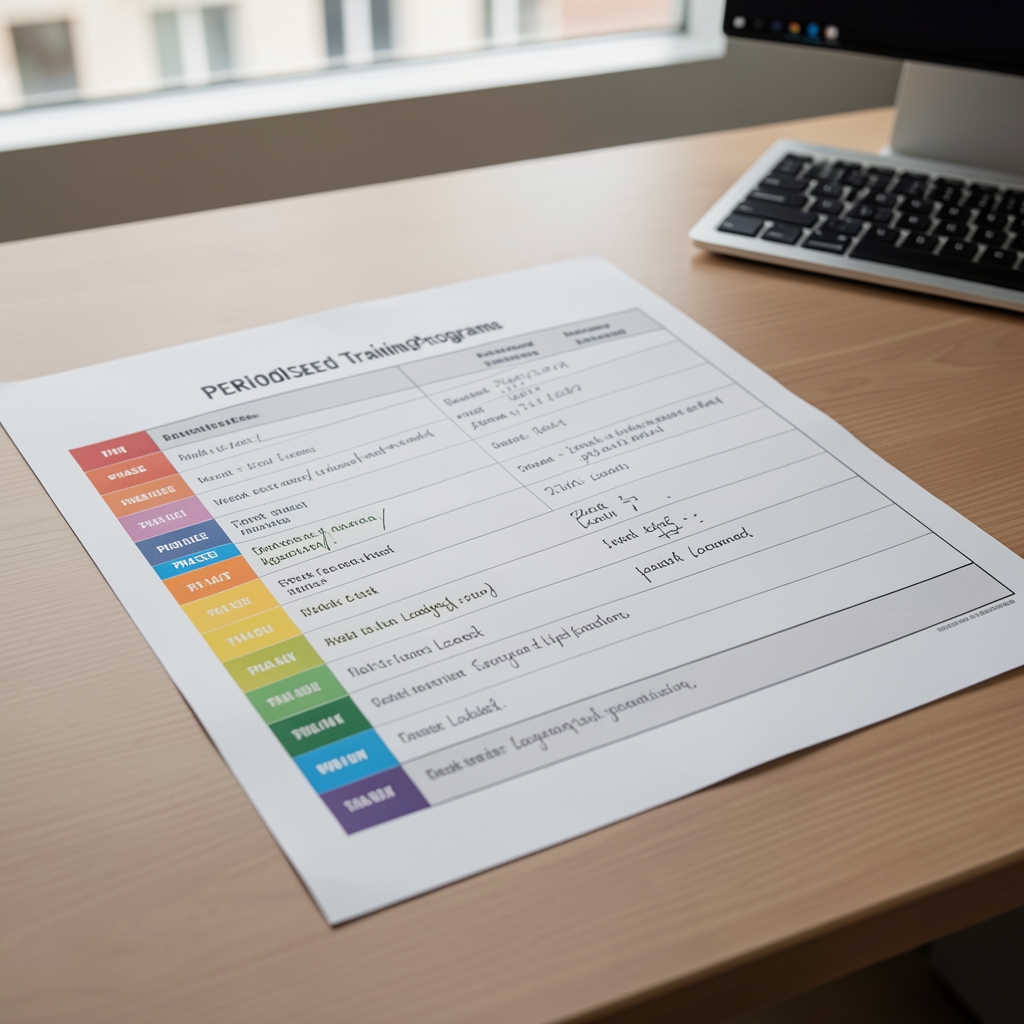
Every block is written as a structured programme document before the first session of that block. The document specifies exercise selection, sets, repetition ranges, loading parameters, and rest intervals for each training day. It is shared with the participant prior to the first session of the block. Changes within the block are made only when the session log indicates a clear need for adjustment.
A session log is maintained for every training session. The log records actual performance against the programme targets — not only the numbers, but movement quality observations and recovery indicators. The log is the primary data source for the phase-boundary review. Participants receive a summary note after each session.
At the end of each block, a formal review is conducted. The review report summarises performance trends, identifies progress against the original objectives, and sets the parameters for the next block. The report is written and shared before the new block begins.
At the end of each full programme cycle (typically 15 weeks), the movement screening is repeated. The repeat screen documents changes in mobility, postural alignment, and movement control. It provides the baseline for the next cycle and a verifiable record of physical adaptation over time.
Most training methodologies answer the first question well. Standard progressive overload, fundamental movement patterns, adequate recovery — these are the established foundations and they are not disputed here. The challenge is not knowing what general principles apply. It is knowing what the specific individual in front of you needs at this specific point in their training cycle.
That knowledge cannot come from a template. It comes from the session log from the last four weeks, the movement screen from the start of the current cycle, and the goal-setting notes from the initial consultation. It comes from documentation.
The Arlonev methodology is not distinguished by unusual exercises, proprietary systems, or novel frameworks. It is distinguished by the discipline of applying standard, well-supported methods with genuine consistency — and by maintaining the documentation that makes consistency verifiable rather than assumed.
Begin with a Consultation
Arlonev includes general nutrition awareness as part of extended lifestyle coaching engagements. The scope is intentionally broad: pre-workout fuel habits, post-workout recovery meal timing, hydration, and daily eating patterns as they relate to training load.
This guidance is delivered through conversation during session recaps and progress check-ins, not as a formal nutritional plan. Where a participant requires detailed dietary programming, a referral to a qualified nutrition professional is arranged.
The rationale for this boundary is straightforward. Broad nutritional awareness, applied consistently, produces more reliable results than a detailed plan followed inconsistently. The scope of guidance delivered reflects what the evidence suggests is most likely to be maintained.
Arlonev is an independent wellness resource focused on everyday fitness and active lifestyle practices. The content of every programme is designed by a certified coach whose qualifications are maintained through an accredited programme with ongoing professional development requirements. Certification documentation is available on request.
Programme design draws on published research in exercise physiology and movement science. Methods are reviewed and updated as the evidence base develops. No proprietary system is claimed — the methods used are standard, well-supported approaches applied with documented consistency.
We recommend speaking with a qualified wellness or nutrition professional before introducing significant changes to your activity level, particularly if you have specific dietary requirements or have been inactive for an extended period.
Read About the Studio